Learn how to design or choose a high-end home beauty device for the U.S. market. This guide covers minimalist design, real performance, professional-focused functions, painless technology, and effective energy output. Discover why OEM/ODM beauty device manufacturers with ISO13485, FDA, and FCC certification support are essential for building premium, reliable, and market-ready products.
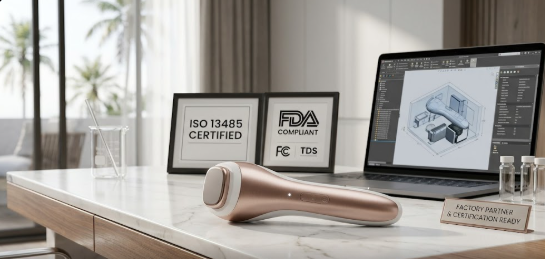
The U.S. beauty device market is evolving rapidly. Consumers are becoming more informed, more selective, and more focused on real results over marketing claims.
For brands entering or scaling in the mid-to-high-end segment, choosing the right product — and the right manufacturing partner — is critical.
This guide outlines the key principles for designing or selecting a premium home-use beauty device that meets market expectations and builds long-term brand value.
In the U.S. market, less is more.
High-end beauty devices are expected to reflect:
A minimalist design communicates confidence, quality, and professionalism — not just aesthetics.
Over-designed products with excessive visual elements often feel outdated or low-end.
Many devices on the market look impressive but deliver very low energy output, resulting in minimal or no visible effect.
A true high-end beauty device should provide:
If a product feels like a “toy,” consumers will quickly lose trust.
Performance is the foundation of brand credibility.
One of the most common mistakes is trying to include too many functions in one device.
While it may seem attractive, this often leads to:
Successful products focus on one core function or a tightly integrated set of technologies, such as:
Depth of performance is more valuable than breadth of features.
Modern consumers expect beauty treatments to be:
Technologies such as optimized microcurrent, controlled RF, and calibrated thermal systems should deliver results without pain or irritation.
A device that causes discomfort will struggle with:
Devices that claim to do everything often fail to do anything effectively.
In the U.S. market, consumers are increasingly skeptical of:
A clear, focused value proposition is far more powerful than a long list of features.
Ultra-compact devices may look convenient, but they often face physical limitations:
A well-designed device should maintain a balance between:
In many cases, slightly larger devices perform significantly better.
A strong factory is not just a supplier — it is a long-term strategic partner.
Key capabilities to look for:
Without proper collaboration, even a good product concept can fail during execution.
Factories with independent research and development teams offer major advantages:
Without R&D capability, brands often face:
Entering the U.S. market requires compliance with multiple standards.
A qualified manufacturer should support:
Certification is not just a formality — it is essential for:
For brands targeting the U.S. mid-to-high-end beauty device market, success depends on more than just product ideas.
It requires:
We are a professional manufacturer specializing in high-end home-use beauty devices, with:
We work closely with brands to develop products that are not only well-designed — but also technically effective, market-ready, and scalable.
The future of beauty devices is not about doing more — it’s about doing the right things, better.
Brands that prioritize performance, simplicity, and credibility will stand out in the competitive U.S. market.