A Technical Guide to LED, EMS, and RF — and Why Some Devices Fail
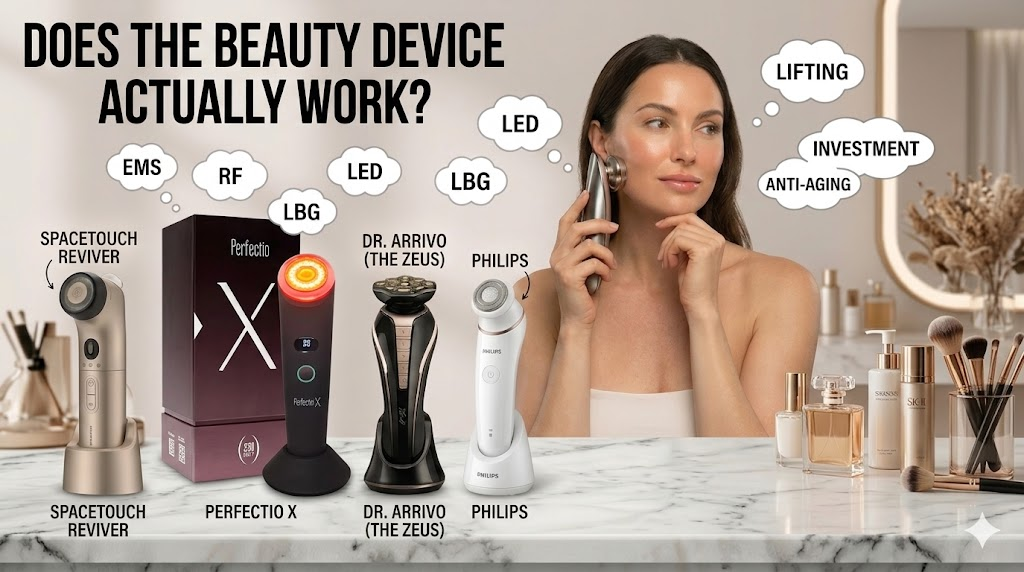
The home beauty device market in the U.S. has grown rapidly over the past few years. Consumers are increasingly looking for non-invasive, effective skincare solutions they can use at home.
But one question continues to come up:
Do beauty devices actually work — or are they just well-marketed gadgets?
The answer is simple:
A beauty device does not work because it has more features — it works because it delivers the right energy, in the right way.
This article breaks down the science behind beauty devices, and explains why some deliver real results while others don’t.
Most home-use beauty devices are built on three main technologies:
Each works differently — and each depends on very specific technical parameters.
Light therapy devices typically use:
Different wavelengths target different skin concerns:
Research shows that low-level light therapy (LLLT) can improve skin condition only when correct wavelengths and sufficient energy are applied (Avci et al., 2013).
👉 Many low-cost devices fail because:
Result: visible light, but no visible improvement
EMS and microcurrent devices are designed to:
But effectiveness is not about “stronger is better.”
Studies show microcurrent can support ATP production and cellular activity (Cheng et al., 1982).
👉 Poorly designed devices often:
The key is controlled, engineered stimulation — not random intensity.
Thermal-based beauty devices include:
These technologies work by:
Clinical research confirms RF can promote collagen contraction and skin tightening (Elsaie, 2009).
👉 If energy is too low:
Despite using “correct technologies,” many devices fail in real use.
Many products are designed for:
But not for actual performance.
Many devices try to include:
All in one product.
But in reality:
When everything is included, nothing is optimized.
This leads to:
👉 In the U.S. mid-to-high-end market, focused devices consistently outperform “all-in-one” designs.
Another overlooked factor is device size and internal structure.
Very compact devices often cannot support:
A well-designed device balances:
Yes — but only when engineered correctly.
A truly effective beauty device must deliver:
✔ Correct wavelength (light therapy)
✔ Waveform + energy coordination (EMS)
✔ Sufficient and stable thermal energy (RF)
✔ Consistent and repeatable performance
✔ Comfortable, pain-free experience
Without these, even advanced-looking devices may function like low-energy consumer gadgets.
The U.S. market is shifting toward:
Consumers are no longer impressed by features —
they are looking for real, visible results.
If you are developing your own beauty device brand, choosing the right partner is critical.
We specialize in:
We don’t just manufacture products —
we help brands create effective, market-ready beauty devices for the U.S. market.
👉 Contact us to start your project
Cheng et al., 1982
Elsaie, 2009